
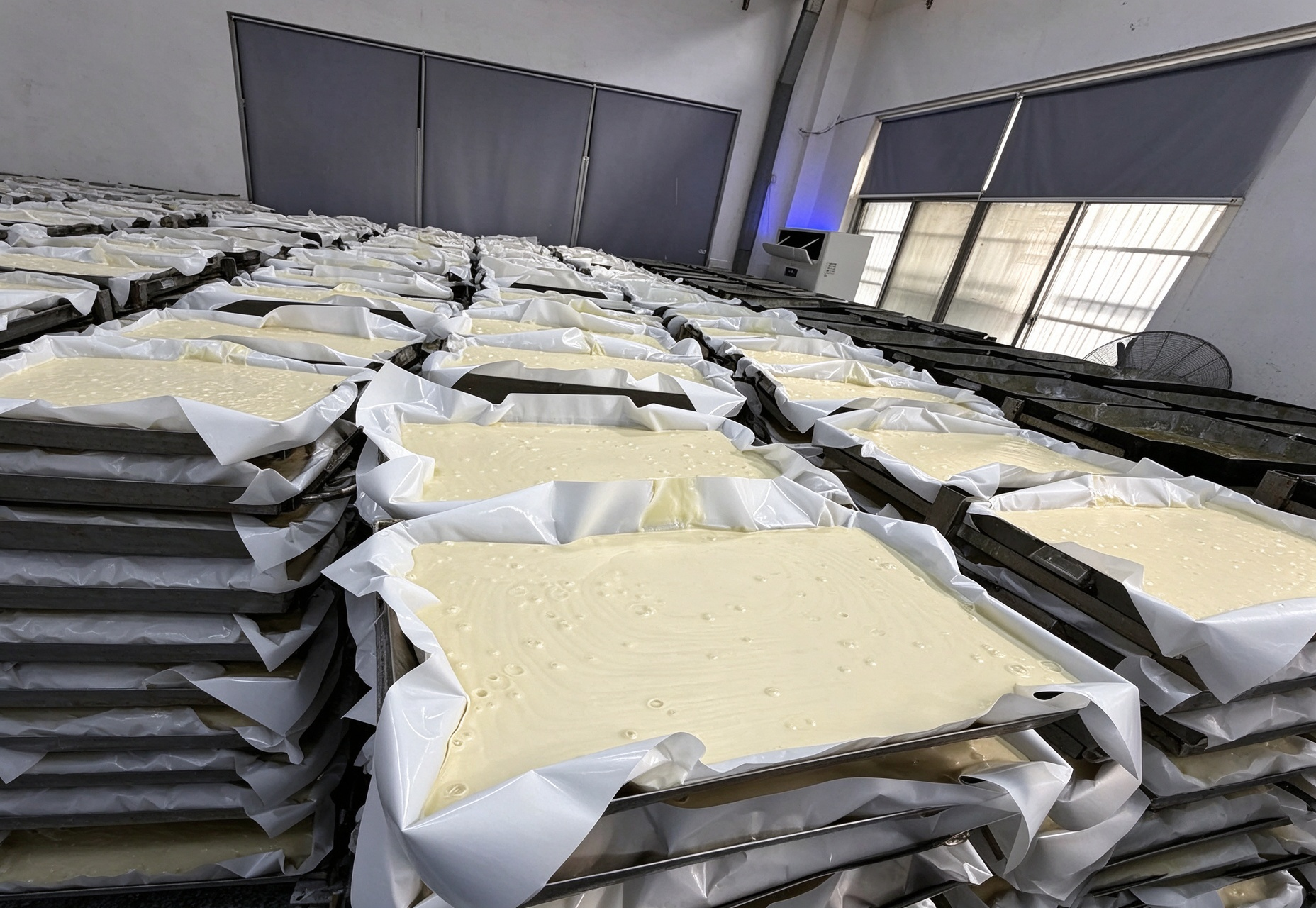
Gum base is made by blending raw materials into a uniform mass, then extruding it at high temperature, sieving, rolling, cooling and cutting it into the forms a chewing gum line needs: granules, blocks, sheets or powder.
This article walks through that process stage by stage as it happens on a real production floor — from raw material intake to the final inspection before dispatch.
What Gum Base Is — And What It Is Not
Gum base is the part of chewing gum that is not sweetener and not flavor: the chewable structure that carries everything else. It goes into your mixer as an input and comes out of your line as finished gum, so its behavior decides how your gum chews, blows and holds up over minutes of chewing — which is why serious buyers evaluate gum base before they evaluate anything else about a supplier, starting with consistency.
Gum base is sometimes assumed to be rubber; it is not. We have covered that question separately — is chewing gum made of rubber? — and a full breakdown of what gum base actually is. This article stays on the process: how the material is actually made.
The Production Process, Stage by Stage
Five stages, in a fixed order.
1. Raw material intake and inspection
Nothing is mixed until incoming materials pass a documented intake check: identity, packaging condition, and batch paperwork. Samples are retained from every lot, so any finished batch can later be traced back to the exact inputs that went into it. For a buyer, this is the first thing to look at on a visit.
2. Mixing
Mixing is where a gum base gets its character. Raw materials are combined in a controlled sequence and heated until the mass is uniform. Temperature and mixing time are set by the formulation, not by operator judgement. Any inconsistency left in this stage does not stay here — it reappears later as texture variation in the finished gum. Buyers rarely see the mixer, so the practical test is indirect: ask how the team knows a mix is finished.
3. Extrusion, sieving and sheeting
The blended mass is fed through an extruder by a pair of screws and emerges as a continuous strip. Between extrusion and sheeting sits a subtle but crucial step called sieving, which checks the strip before it passes through rollers that set its thickness. This is the point where batch production becomes continuous production: as long as the line runs, sheet keeps coming off the end. Thickness is controlled mechanically, which is what keeps sheet-to-sheet variation low across a run. For sheet buyers this stage effectively is the product; for every other form it still matters, because a strip that varies here forces corrections downstream.
4. Cooling, cutting and forming
Fresh off the rollers, the material is soft and needs to cool to a stable state before it can be handled further. Once cooled, it is processed into the delivery form the customer’s line requires: cut into blocks, granulated, or milled into powder. This is the stage that gives one base material its several shapes — everything before it is identical; what changes is the forming step at the end. Granulation and milling have their own tolerances. In a well-run forming area, particle size and block dimensions are controlled to specification rather than left to vary from batch to batch.
5. Inspection, packing and dispatch
Before packing, finished goods go through a final check: form and appearance, packaging integrity, and batch documentation. Only then are pallets wrapped and loaded for dispatch. Want this level of process discipline in your supplier? Request specifications and samples at [email protected].
Why the Same Process Produces Four Different Shapes
Gum base leaves a factory in four forms: granules, blocks, sheets and powder. The differences are handling differences, not quality grades. Chewing gum lines feed gum base in different ways — some melt it, some dose it, some feed it directly — and each form exists to match one of those feeding systems. The same base can move between forms without any change to the recipe behind it.
Granule gum base, block, sheet and powder each suit a different line setup. The practical question is therefore not "which form is best" but "which form matches how my line takes material in" — ask that before you compare prices; it narrows a supplier list faster than any other question. An overview of all four forms is here.
What to Check on a Factory Visit
If you visit a gum base factory — in person or by video — the checklist below turns a tour into evidence.
| Check | What a good answer looks like |
|---|---|
| 1. Raw material intake | Incoming lots are checked against documents before entering the warehouse; samples are retained. |
| 2. Batch traceability | The team can trace any finished batch back to its input lots without searching for records. |
| 3. Mixing control | Formulation parameters are set per recipe and recorded, not adjusted by feel. |
| 4. Extrusion line | The strip comes off continuously and steadily, without frequent stops or manual patching. |
| 5. Forming area | Cutting, granulating and milling areas are organized by grade or customer, not mixed together. |
| 6. Final inspection | There is a visible inspection step between packing and dispatch — and it is written down. |
| 7. Warehouse practice | Finished goods are stored by batch, so any release can be traced or reversed if needed. |
| 8. Documentation | A spec sheet and a batch COA can be produced on request. |
FAQ
What are the main steps in gum base production?
Five, in a fixed order: raw material intake and inspection, mixing, extrusion and sheeting, cooling with cutting or forming, and final inspection before packing and dispatch.
Why does gum base come in granules, blocks, sheets and powder?
Gum base comes in four forms: granules, blocks, sheets and powder. Production lines differ in their level of automation, and that decides which form fits. The right one depends on how your line handles the material, whether by melting, dosing or direct feeding, not on a quality ranking among the four forms.
Where can I buy gum base for manufacturing?
From specialized gum base manufacturers. NICE GUMBASE (NICEWELL GROUP) supplies gum base in 260+ formulations, with flexible MOQ for trial orders and bulk production and a 10-15 working-day lead time. Request specifications and samples at [email protected].
Every batch of NICE GUMBASE gum base is built the same way: documented intake, recipe-set mixing, mechanically set thickness, and a written release. That is how 260+ formulations reach 50+ countries with the same chew, batch after batch. Request specifications and samples at [email protected].